Acoustics · Free tool

Speaker Placement Planner

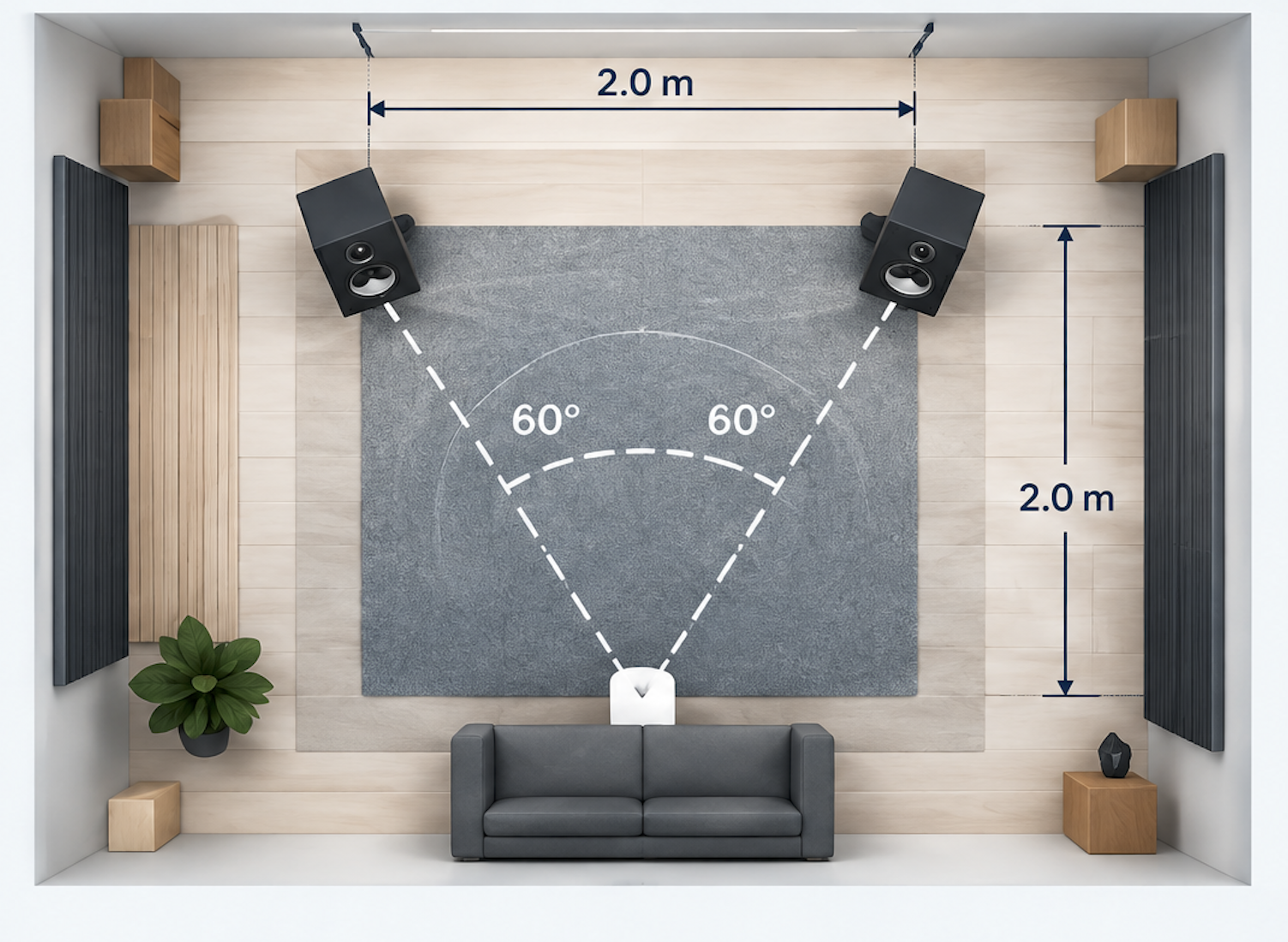
Enter your room dimensions and get a labeled starting-point layout for your monitors and listening position — an equilateral triangle check, a symmetry check, and a boundary interference (SBIR) reference frequency.
Learn the physics behind the triangle →

Top-down studio diagram showing two monitors, the listening position, and a 60-degree equilateral triangle
Listening position from front wall
—
~38% of room length — starting point, refine by ear.
Speaker distance from front wall
—
Pulled off the wall to reduce SBIR.
Speaker distance from side wall
—
Equal on both sides, for symmetry.
Speaker-to-listener distance
—
Speaker-to-speaker ≈ speaker-to-listener.
Side-wall symmetry
—
Can the layout fit symmetrically?
Approx. first boundary null
—
SBIR reference frequency, not a precise prediction.

Every number here is a labeled starting-point heuristic, not a fixed rule — refine by ear and by measurement once your speakers are in the room.

Room layout (top-down)

Starts from the recommendation above — adjust the sliders to try a different layout and see the warnings update live.

First reflections & boundary interference

Assumes a tweeter/ear height of about 1.2 m (not entered above) — treat reflection points as the center of a treatment area, not a single pinpoint.

Side-wall reflections (top-down)

Boundary interference (SBIR), front wall

Continue planning your studio

With the layout in place, check how live the room is and how much treatment to start with. If you want to compare two layouts side by side, with boundary-cancellation estimates, in a workbook you keep, that is part of the Studio Project Workbook in the Studio Acoustic Toolkit.

Plan, listen, then measure

This speaker placement calculator provides a geometric starting point for a home studio. Furniture, boundary materials and room asymmetry affect the result. Use placement experiments before planning permanent acoustic treatment.