DIY Block Diffuser Calculator
Plan a square wooden block panel. Choose your dimensions, calculate each block height and print the cut list.
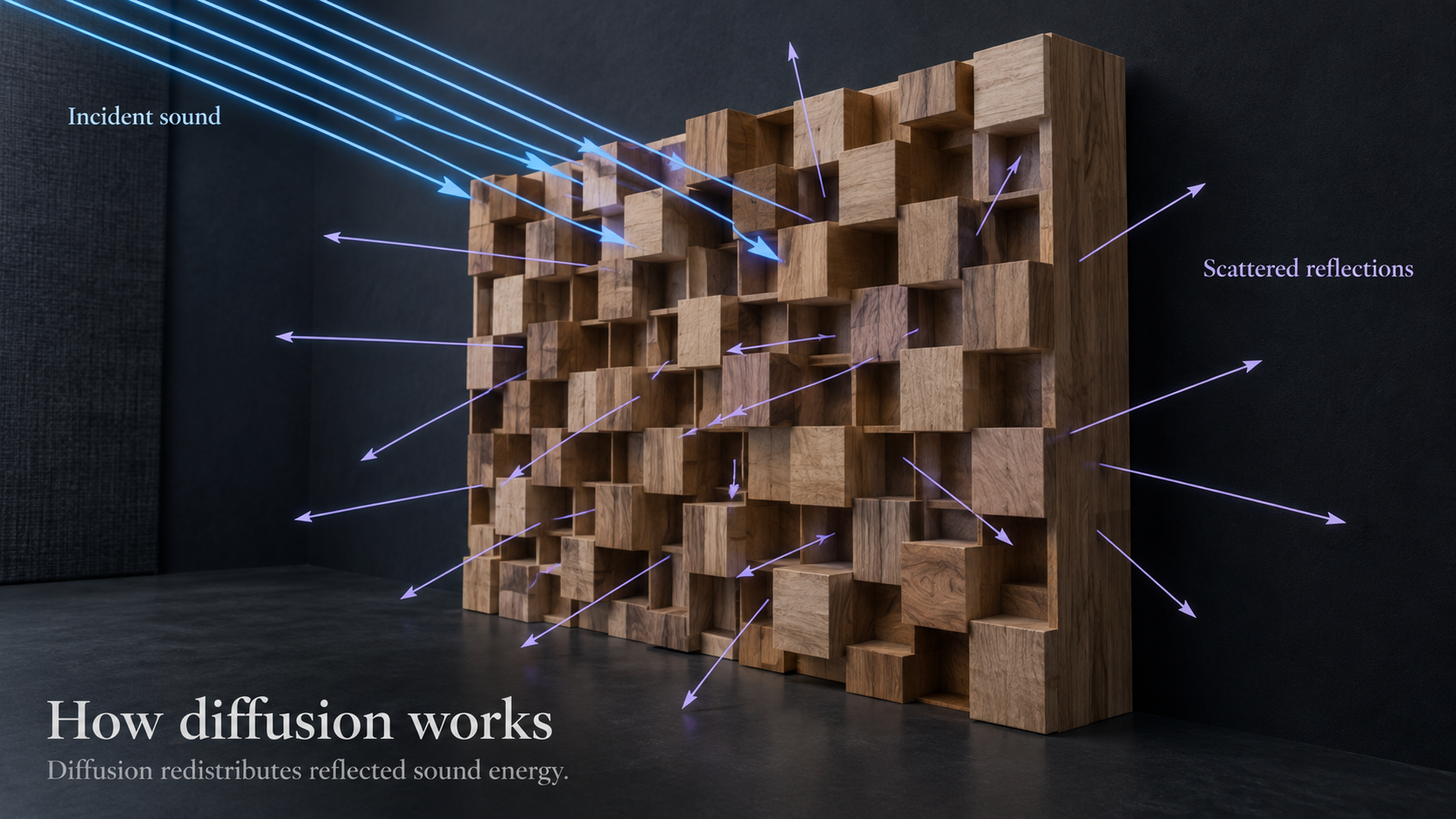
Your build plan
Front-view layout · block height in mm
Top row = top of panel. A zero is an exposed backing-board position, not a block to cut.
Cut list
| Height (mm) | Quantity | Stock length including kerf (mm) |
|---|
How this plan works
The two-dimensional residue sequence is s = (x² + y²) mod N, with x and y from 0 to N − 1. Reference well depth is d = s × 343000 / (2 × N × f) mm. Block heights are the complementary surface: h = maximum(d) − d. Heights are rounded to 0.1 mm for the cut list. Sound speed is fixed at 343 m/s.
This is a single-period, finless block layout. Open blocks do not behave identically to separated QRD wells. The design frequency and width-based frequency scale are geometric references, not a verified operating band. Finite size, placement, material and repeating identical panels all affect scattering.
Use square stock of the chosen width, with no gaps assumed. The backing board, frame, fixings and stock-end trimming are not included in the timber estimate. Allow extra stock for defects and mistakes. Check the finished panel weight and use wall fixings suitable for your wall and load; diffusion does not replace bass trapping or absorption.
Method references: experimental research on 2D quadratic-residue diffusers and QRDude design notes. Read Absorption vs Diffusion for placement context.